An article by Rebecca Mazzon
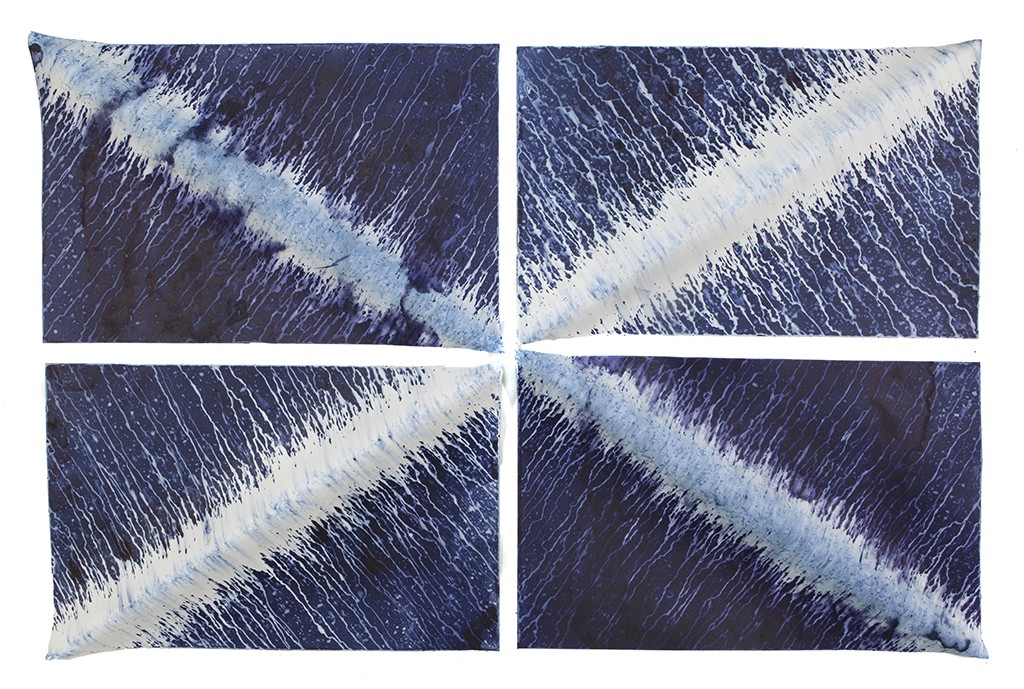
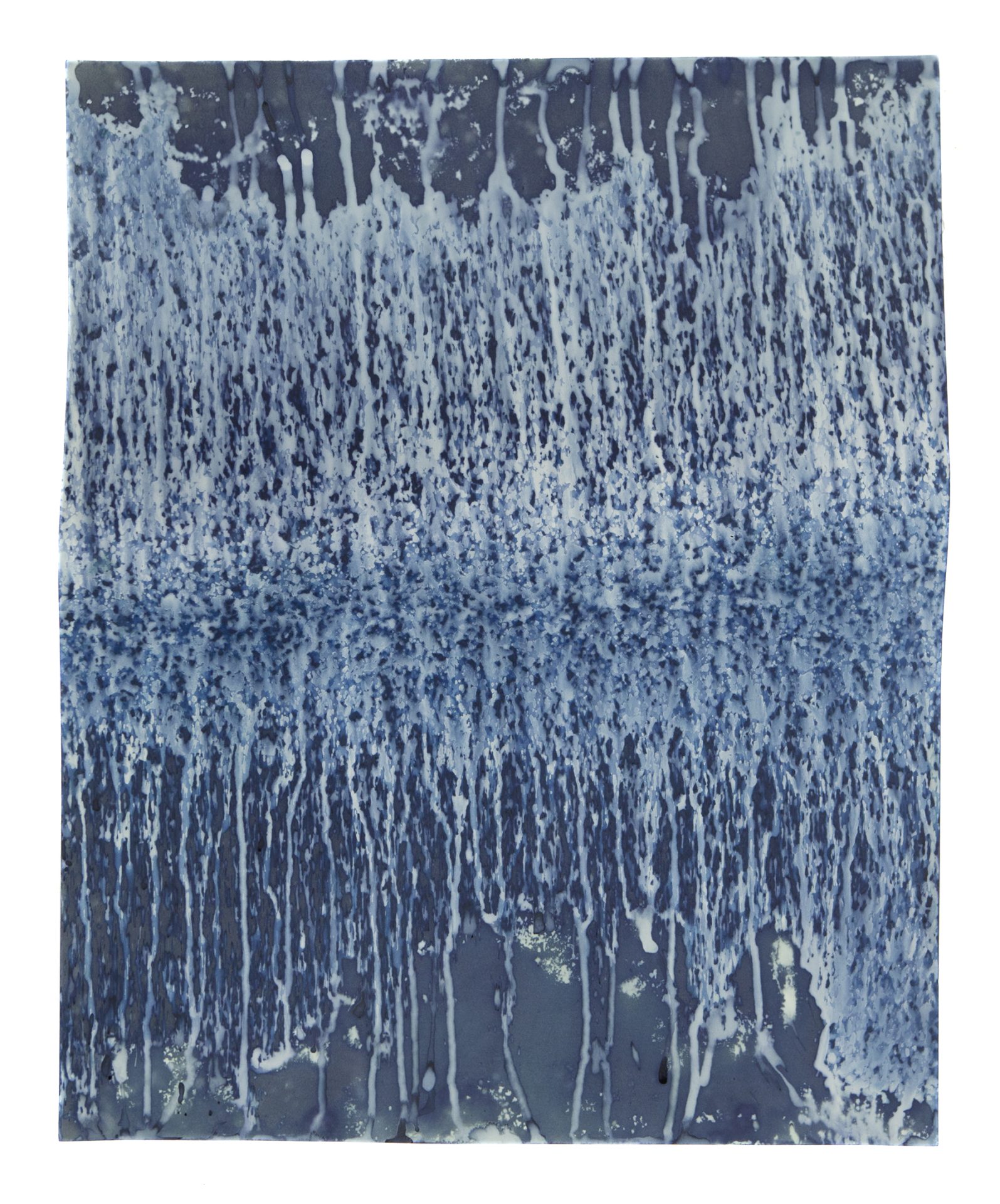
Meghann Riepenhoff is an artist based between Bainbridge Island, near Washington, and San Francisco: the West Coast is her home and Bainbridge Island is where she gets inspired the most. Riepenhoff was born in Atlanta in 1979 and after a Bachelor of Fine Arts in photography from the University of Georgia and a Master of Fine Arts from the San Francisco Art Institute she started working, becoming famous for her practice, using yanotypes in an unconventional way, pushing the technique beyond its traditional use. Littoral Drift is the name of the work that probably made Riepenhoff recognisable: the first exhibition of this project dates back to 2015, when in December she had the chance to exhibit her work alone at SF Camerawork, an Art Gallery in San Francisco founded in 1974. Littoral Drift has been later exposed in many other galleries and publications, however Riepenhoff’s use of cyanotypes had just begun, and in 2019 she realized another project called Ecotone,expanding her cyanotype practice beyond the ocean but also to rain, snow and ice, first exhibited at Yossi Milo Gallery in New York. The exposure of photosensitive paper to cold environments kept intriguing and inspiring her, and in 2022 Riepenhoff realized another work: Ice, allowing snow, crystals and ice to leave their mark on the photosensible surfaces, revealing interesting textures and images. Obviously Meghann Riepenhoff’s creativity doesn’t stop here: just like her work, she just keeps evolving. In 2025 at Heines Gallery in San Francisco, Riepenhoff presented State Shift, a project about climate devastation, but that preserves the possibility of hope and transformation towards the place we live in. Talking about her work “chaos with a dash of control” is the description that gives Meghann Riepenhoff of her production -and her life as well. About her feelings during the process, she narrates how she feels excited when she is on the beach doing her work, but also anxious, hopeful. “When trying to make interesting pictures, things are potentially quite chaotic and really out of control. And I think that there is a way that the physical movement gives some sort of outlet for all of the emotions and sort of psychical states that come in that vulnerable space of making art.” she adds. Manual skills are a fundamental part of her work: Riepenhoff doesn’t just do little images in a small layout, she also operates with big sized surfaces, sometimes producing wall sized images. To realize the cyanotypes Riepenhoff has to transport her papers to the beach, leave them there for many hours, in whatever weather conditions she has chosen. The physical part of her process seems to allow her to “feel” or maybe even “embody” the work she is doing, creating a special connection with the environment and, since the environment is the one to have some sort of control over the image that it is going to create, trusting it.
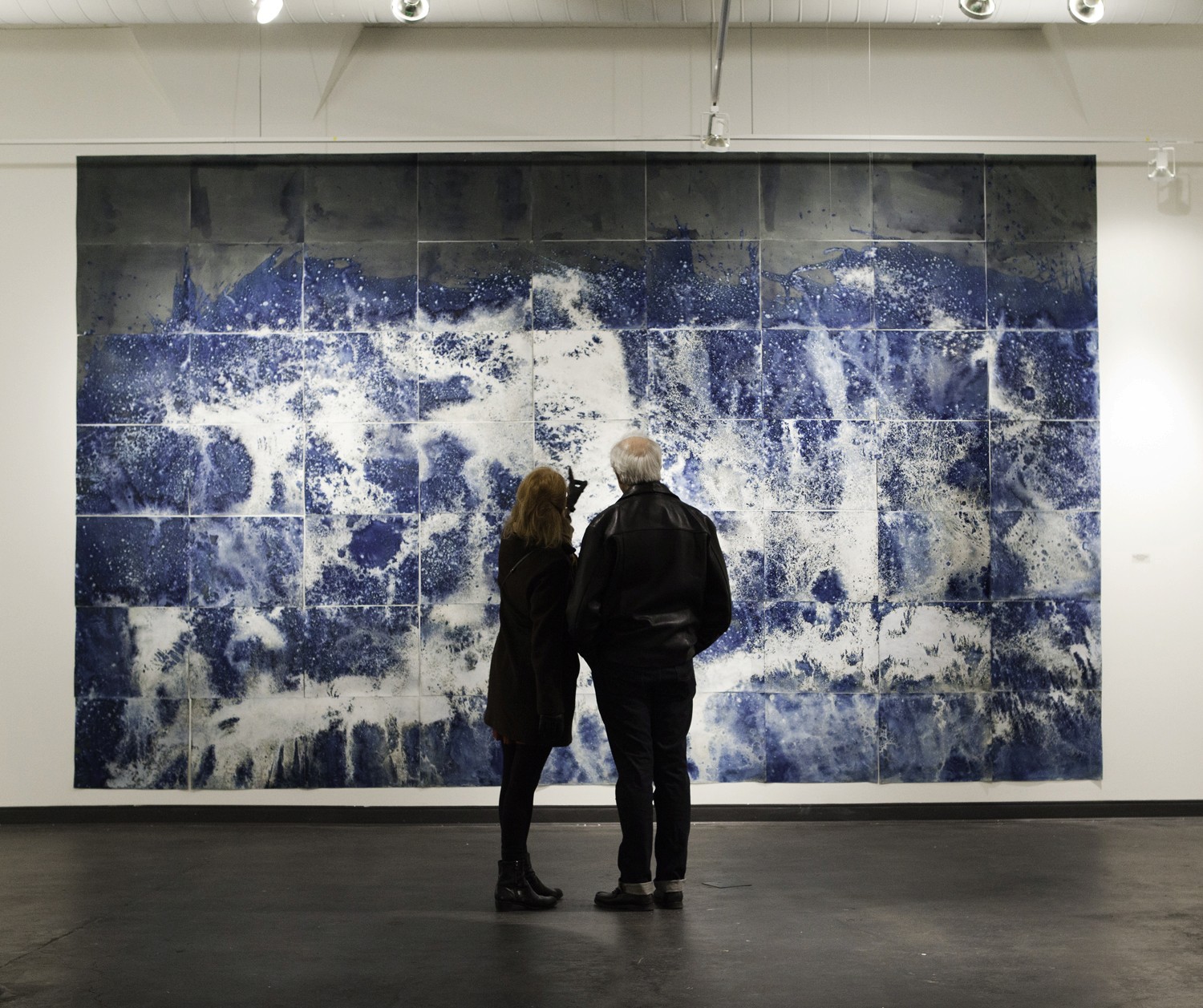
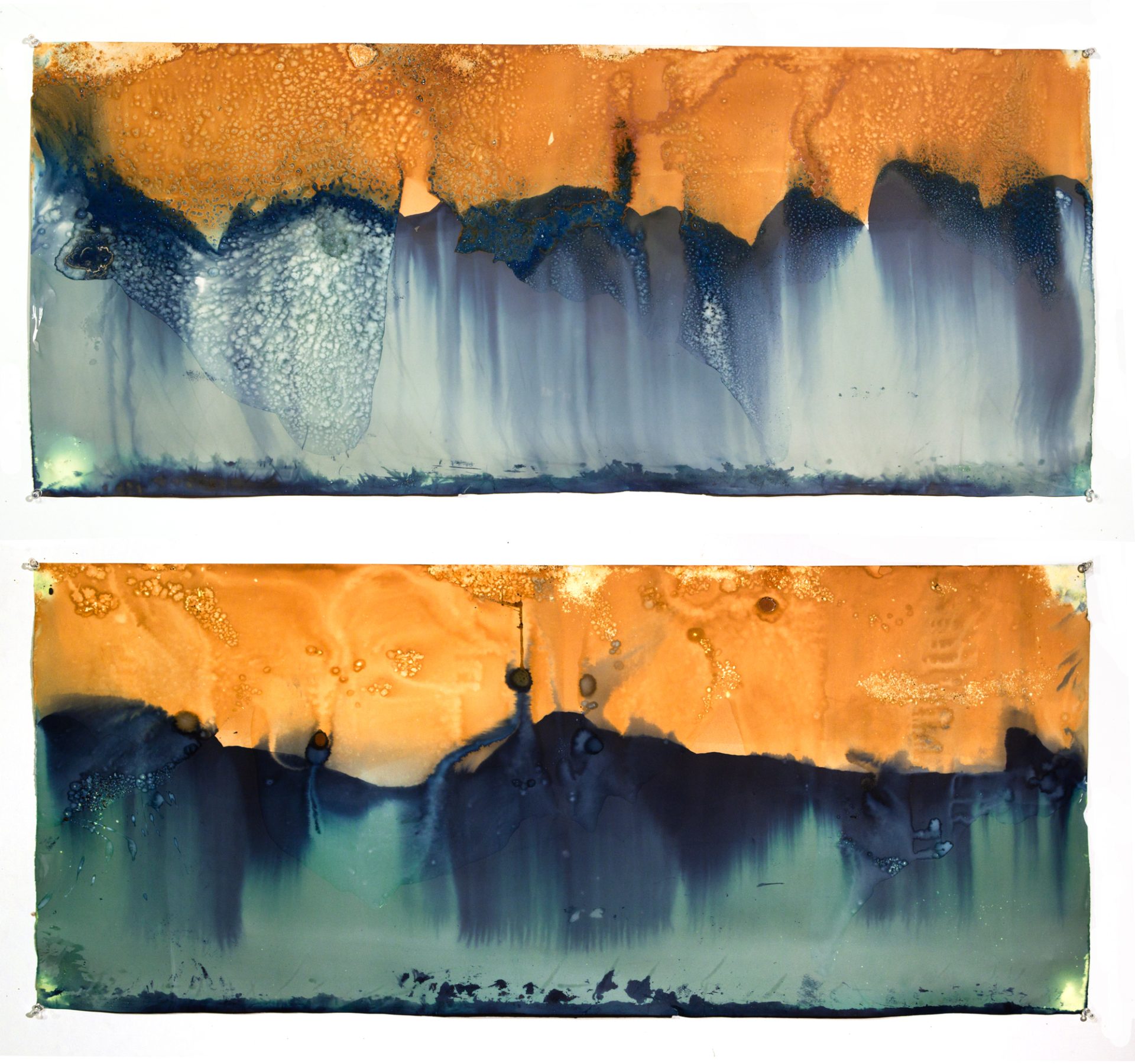
Looking at her work, you may not understand at first what you are looking at: it could be a painting or a photograph, colors are intense but also smooth, shapes are mysterious, as if she had dropped some paint on a canvas. Even if you do not perceive it, images are constantly changing, evolving, transforming into something else: like the ocean, you may think you are looking at the exact same thing, but the subject is constantly moving, becoming something else than it was before. This aspect is something fascinating about Riepenhoff’s work and it happens because the materials keep reacting at the surrounding environment: if you buy one of Riepenhoff’s works, you may find yourself owning a totally different image from what it was when you bought it, and that is part of the appeal. Looking at her work, “imprecision” is a word that could be used to talk about Riepenhoff’s practice, letting us reflect on our current way of living. Imprecision is the element we don’t talk about, like an inconvenience we don’t want to experience, that could be a bad movie we spend two hours watching or an awful restaurant we tried one night, reviews written with an extreme precision are like a medium that filters our activites, trying to avoid a waste of money or time. In an environment suffused with highly manipulated imagery, Meghann Riepenhoff does not care about perfection, she lets nature take care of the final result. Modern technology is in a constant search for perfection, with images that aim to look as real as possible: Riepenhoff removes that, as if to demonstrate her disinterest in something people are so eager about, as if to praise the immaterial waste in our lives. In a world where everything can be an ever-evolving medium Meghann Riepenhoff does something significant, in a world where everything has been done she takes something away from what it was meant for, giving it a different perspective, giving us a perspective from which we can question something else.