Anna Atkins: The Blue That Changed How We See
Letting nature draw itself
Let’s go back to that blue we began exploring last month. While theory explained how light and iron salts "write" on paper, today’s story shows us how that chemical process can become poetry, archive, and revolution. It’s all thanks to a woman who, in the mid-19th century, dared to look where others didn't: Anna Atkins.
Picture the 1840s—an era when photography was a newborn invention, an experimental territory dominated almost exclusively by male perspectives and cumbersome equipment. In this landscape, Anna Atkins was much more than a spectator. A passionate botanist and curious mind, she realized before anyone else that cyanotype wasn’t just a magical trick of light, but a powerful—and affordable—tool to document the complexity of nature with unprecedented fidelity.
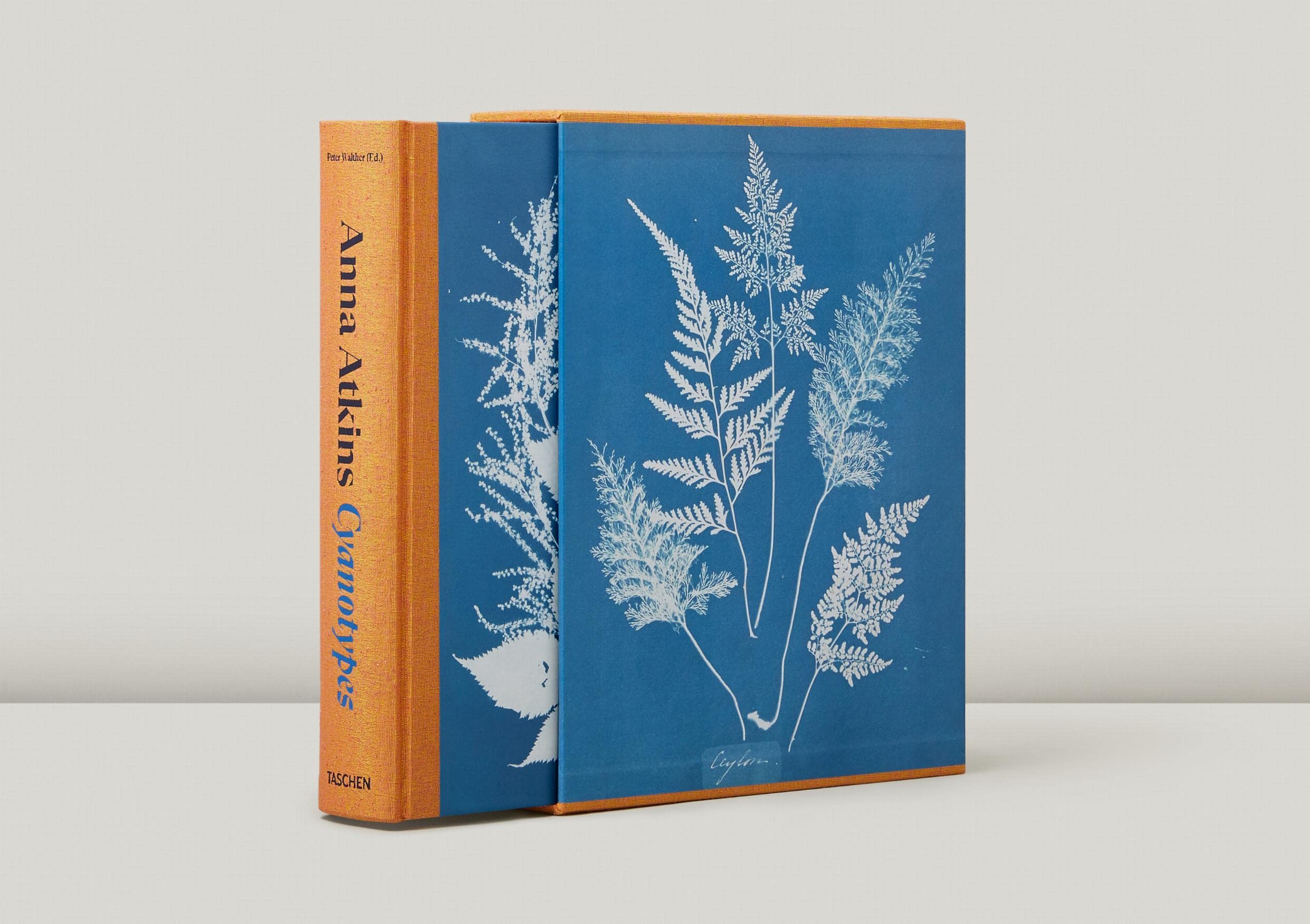
In 1843, Anna published Photographs of British Algae: Cyanotype Impressions. This wasn't just any book: it was the first-ever volume in history to be entirely illustrated by photographs. It’s a milestone we often overlook, but it changed the worlds of publishing and science forever. (Source: NYPL – New York Public Library)
Her insight was as simple as it was brilliant: why struggle with pen and paper when you can let nature draw itself? Before her, herbariums were the result of manual interpretations, where the illustrator’s eye could—even unintentionally—distort reality. Anna decided to remove this "human mediation." By placing seaweed directly onto photosensitive paper, she turned the plant into a living negative. The resulting image wasn't a copy, but the exact, millimeter-perfect, and honest imprint of the subject.
This wasn't an isolated experiment or a passing hobby. Anna dedicated ten years of her life to this mission, producing thousands of handprints with almost monastic devotion. It is thanks to her persistence that this practice, initially considered "minor," became synonymous with elegance and scientific rigor. For her, photography was a way to freeze time and create an archive of knowledge that was, simultaneously, a work of art.
It is fascinating to see how this need to "freeze time" has been turned on its head today in the work of American artist Meghann Riepenhoff. (Source: V&A Museum)
While Anna sought total control to create a static, perfect archive, Meghann does the exact opposite: she embraces chaos. While Anna worked protected in her studio, Meghann takes her massive sheets of paper to ocean shores or out into the driving rain. She doesn’t want to isolate the subject; she wants nature to be the sole author of the work. The waves, sand, and salt react freely with the chemistry, creating powerful abstract images that are no longer catalogs, but fragments of a living, unrepeatable event.
Two approaches, two philosophies, one single color. On one hand, Atkins teaches us the value of observation, where every detail saved from oblivion is an act of care. On the other, Riepenhoff reminds us of the beauty of the process, where the unexpected becomes the truest part of the work.
Ultimately, cyanotype tells us exactly this: whether we are cataloging a piece of seaweed with precision or letting ourselves be swept away by a wave, creativity remains a constant dialogue between our desire to order the world and the courage to let it flow.